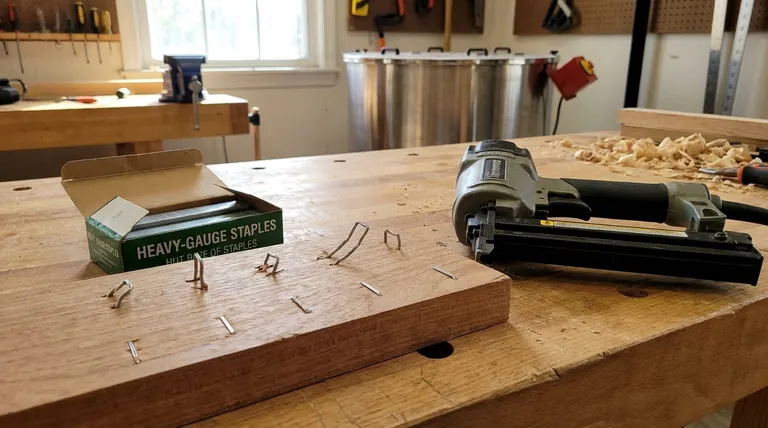
In industrial staple procurement, a very common and costly question is: how can you quickly tell whether the quality of a batch of staples is truly reliable – before buying?
Whether you are a trader, brand owner, furniture factory, wholesaler, or any professional buyer, once you receive samples, you need to check three things:
- Smooth feeding – Does the staple gun operate without jamming or misfiring?
- Stable driving – Do staples penetrate the material without bending, skewing, or breaking?
- Batch consistency – Are all strips and individual staples alike?
If any of these three fails, the consequences will hit your production line: downtime, rework, efficiency loss, and customer complaints. Staples are cheap, but staple problems are expensive. Judging quality before purchase is more important than anything else.
💡 This guide gives you a 10-minute practical routine to evaluate any sample batch.
Method 1: Evaluating Industrial Staples Quality through Appearance & Workmanship
The goal is to quickly eliminate products with obviously unstable manufacturing – no tools needed, just your eyes.
1. Surface treatment (Rust prevention)
Even, bright coating, no rust spots, no oxidation blackening, no oil stains.
Early rust spots indicate inadequate anti-rust treatment. In long-term storage or high-humidity shipping, the risk of further corrosion is high.
For ocean freight or warehousing with variable conditions, poor surface quality becomes a major liability.
2. Glue condition (Feeding stability)
Glue layer is even and continuous – no excessive buildup, no missing glue.
Uneven glue distribution can cause abnormal sticking or separation between staples, increasing the chance of feeding problems (jamming or misfiring) during use.
In high-frequency usage scenarios, feeding stability is the first issue to become apparent.
3. Forming transition area & surface burrs (Structural stability)
Smooth transition from leg to crown, no cracks, no noticeable burrs.
Cracks or obvious structural defects indicate unstable forming processes, raising the risk of breakage during driving. Burrs may not directly affect strength, but they often reflect poor stamping or mold control.
Rough workmanship tends to cause instability down the line.
4. Leg consistency
Two legs are equal in length, parallel, no inward/outward splay.
Visible leg length difference or deviation increases the chance of skewing during driving, leading to uneven force and unreliable fastening.
This kind of problem can be spotted with the naked eye – no special tools needed. If present, treat it as a batch risk.
Method 1 summary: Appearance inspection focuses on structural stability. If obvious defects exist, generally do not proceed to dimensional or performance testing.
Method 2: Dimensional Accuracy – A Key Factor in Industrial Staples Quality
Dimensional accuracy isn’t about absolute perfection – it’s about answering: Does the batch meet specs of drawing, and is it consistently within range?
Key dimensions to measure (use calipers or a micrometer)
- Crown width (outer shoulder width)
- Leg length
- Flattened wire width
- Flattened wire thickness
- Strip width
How to measure: A three-step method
Step 1 – Observe whole strips side by side. Place multiple strips together and visually check if lengths and widths are consistent, without obvious tilting or height differences.
Step 2 – Measure whole strips. Use calipers to measure crown width, strip width, and leg length. Compare data across different strips. Measuring whole strips gives you a quick view of whether overall dimensions are within spec, and shows you variation between strips.
Step 3 – Random single-staple sampling. Randomly pick individual staples from different strips. Thoroughly remove glue residue, then measure flattened wire width and thickness. Confirm values are within spec with no major outliers.
After these three steps, you’ll be able to judge: Is there batch variation? Any local anomalies? Does the product have a stable foundation for use?
Method 2 summary: Dimensional consistency determines the stable foundation for batch usage. It’s a critical indicator of the supplier’s quality control level. Only dimensionally stable products are worth moving on to real-life testing.
Method 3: Real Performance Testing – The Final Step to Evaluate Staples Quality
Appearance and dimensions are just screening tools. The final verdict must come from actual use.
How to test
Use the actual staple gun model you’ll be using in production, and work with real materials (e.g., wood, engineered wood, or packaging material). Drive dozens of staples continuously (at least 50–100 shots) and focus on two things:
1. Feeding smoothness
Pull the trigger repeatedly. Observe any jamming, misfeeding, or unstable feeding. This directly affects operational efficiency, and problems are magnified under high-frequency use.
2. Driving result
After each strip, inspect every single staple. A qualified staple should penetrate straight into the material, with the crown flat against the surface. The following are unacceptable:
- Bent staples
- Broken staples
- Lifted or popped-up crowns
- Incomplete penetration (half-driven)
Why is this so important? This is the most intuitive quality signal. If a staple bends, breaks, or sits crooked, that fastening has already failed. On the production line, workers have to stop and fix it; damaged workpieces may need rework or even scrap. An occasional bad staple can happen, but repeated occurrences indicate a batch problem – and customer complaints will follow immediately.
Method 3 summary: Real-world testing reflects overall system stability. Whether the staples work reliably in your actual process is the final judge.
10-Minute Quick Decision Model for Industrial Staples Quality
Once you receive samples, follow this rhythm:
| Step | Content | Time |
|---|---|---|
| Appearance | Structure, glue, burrs, overall consistency | 2 min |
| Dimensions | Whole-strip observation + sampling verification | 5 min |
| Performance | Feeding + driving test with real gun & material | 3 min |
✔ Suitable for long-term cooperation: No obvious appearance defects, stable dimensions, smooth feeding and driving.
⚠️ Observe or use as backup: Generally acceptable appearance, minor dimensional fluctuations, occasional unstable firing.
❌ Not recommended for cooperation: Obvious appearance anomalies, large dimensional variation, unstable performance.
💡 Remember: Staples are cheap, but staple problems are expensive. Judge before you buy – it’s more important than anything else.
FAQ – Common Questions About Evaluating Industrial Staples Quality
Q1: What is the most important quality indicator for industrial staples?
Appearance consistency, dimensional stability, and real-world performance.
Q2: Does sample approval guarantee bulk order quality?
Not necessarily. Bulk quality depends on batch-to-batch stability and the supplier’s production control. Always include quality clauses in your contract specifying sample standards and incoming inspection criteria.
Q3: What are the most common usage problems?
Jamming, misfeeding, bent staples, and broken staples.
Q4: How can I tell if a supplier is reliable?
Evaluate their consistency across multiple batches and long-term delivery stability. Sample approval is just the first step; a reliable supplier should provide inspection reports and accept third-party testing. Track record matters more than a single perfect sample.
© Practical guide for procurement professionals. Use it to protect your production line from hidden costs.
Want to share this guide? Please link back to the original source.